
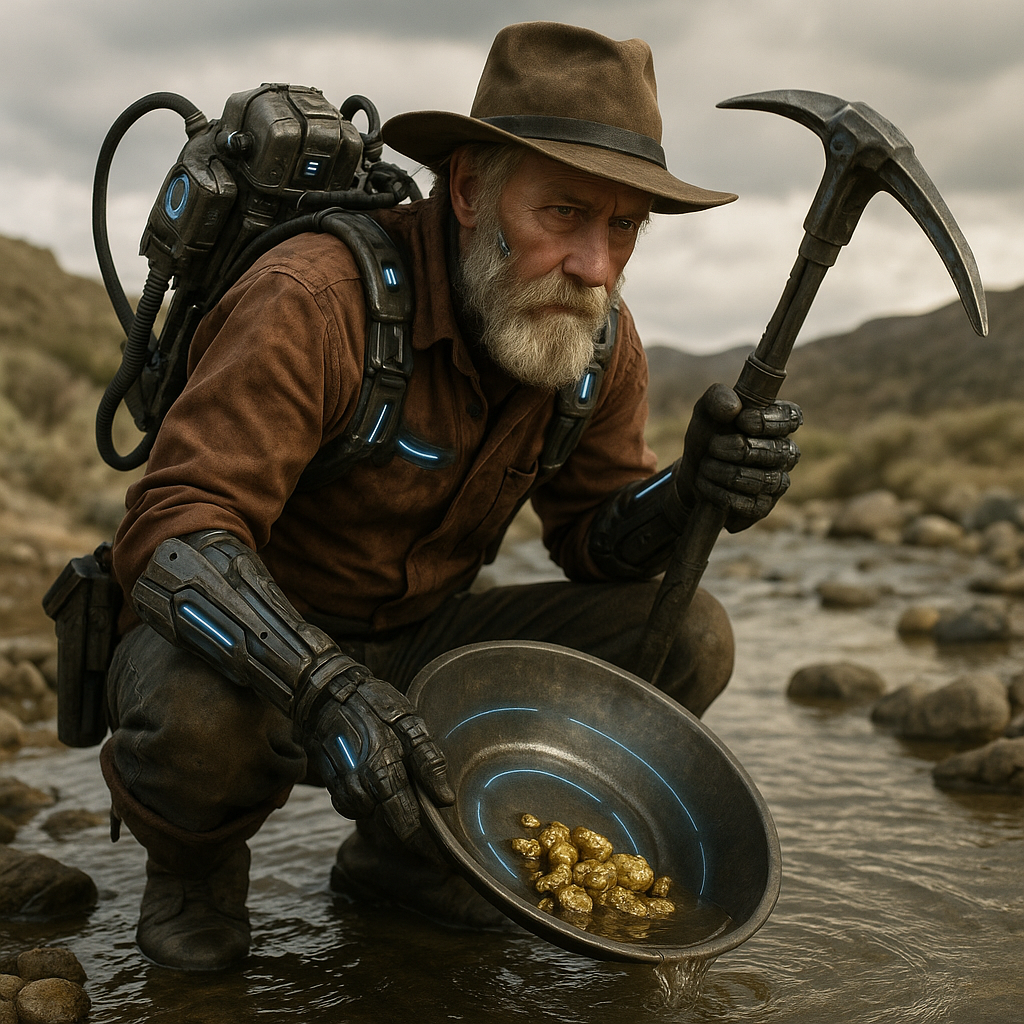
In the mid-1800s, thousands of dreamers left everything behind to chase gold in California. They sold their homes, borrowed from friends, and journeyed across continents with little more than a shovel and a story.
Most found nothing. But a few made their fortunes and shaped history.
Today, I see the same pattern repeating — only this time, the gold isn’t buried in rivers and rock. It’s hidden in data. The prospectors are founders. The claims are AI products.
Welcome to the AI Gold Rush.
Staking the Digital Claim
During the Gold Rush, fortune seekers raced to stake their claims, often with no geological expertise — just optimism and luck. They’d seen others succeed nearby and thought, “Maybe there’s gold under my feet too.”
That same psychology drives today’s AI boom. Startups are staking digital claims in the unexplored frontier of artificial intelligence. They raise investment, hire engineers, and start digging — into datasets instead of dirt — in search of something valuable beneath the surface.
The parallels are uncanny: speculation, speed, and the constant hope that this claim will be the one that changes everything.
The Real Winners Sell the Tools
In the 1850s, most miners went home broke. The real winners were the suppliers — those who sold picks, pans, and tents to the hopeful masses. Levi Strauss didn’t dig for gold; he sold denim to the men who did.
The same is true in AI.
Today’s “tool merchants” are companies like NVIDIA (selling GPUs), AWS, Google Cloud, and Microsoft Azure (leasing compute power), and data infrastructure platforms that manage and refine the raw material — data.
They don’t care who strikes gold. They profit from the digging itself.
And just like the merchants of the 1850s, their profits are guaranteed as long as the rush continues.
The Mirage of Riches
Every gold rush runs on stories — legends of lucky miners who became rich overnight. Those tales pull in more dreamers, more capital, and more risk.
The AI boom is no different.
Every week, we read about billion-dollar valuations, overnight unicorns, and “revolutionary” products that promise to reshape industries. Yet beneath the surface, many of these ventures are speculative — built on the same foundational models, with little defensible differentiation.
The psychology is the same: FOMO fear of missing out.
Investors don’t want to miss the next OpenAI. Entrepreneurs want to ride the next tech wave, engineers want to build cool stuff, watch their dream product come to life and find a breakthrough. And so the cycle accelerates — until the reality check arrives.
The Hard Work Beneath the Glamour
Mining wasn’t glamorous. It was cold, wet, dangerous work — far removed from the romantic image of striking gold in the sunlight.
AI development carries its own version of hardship. Once the hype fades, founders discover the real grind:
- Endless data cleaning and labelling.
- The complexity of model tuning and deployment.
- Regulatory and ethical challenges.
- The spiralling cost of compute.
- The enormous cost of customer acquisition and support
- The relentless race to stay ahead of the competition
Like the miners before them, many underestimate how much sweat it takes to turn potential into value.
Finding AI gold — genuine product-market fit — takes endurance, not just funding.
Boomtowns, Ghost Towns, and Market Cycles
San Francisco grew from a tiny port to a thriving city because of the Gold Rush. But for every San Francisco, there were hundreds of ghost towns — abandoned once the gold ran out.
AI is following a similar curve.
Cities, sectors, and startups are branding themselves as “AI-powered.” Investment is flooding in. But when the easy wins are exhausted, consolidation will hit hard.
The companies that survive will be those that build infrastructure and deliver sustainable value long after the hype fades.
The rest will become digital ghost towns — reminders of a fever that burned too bright.
Prospectors to Settlers
Eventually, the chaos of the Gold Rush gave way to something more enduring. The settlers arrived — people who built railways, banks, and businesses. They weren’t chasing gold anymore; they were building civilization.
That’s where the AI landscape is heading now.
The “wild west” phase of AI — all exploration, little regulation — is giving way to structure and maturity.
- Enterprises are integrating AI quietly into operations.
- Governments are introducing frameworks for ethics and safety.
- Investors are moving from speculation to sustainability.
The next generation of AI leaders won’t be the prospectors. They’ll be the settlers — builders who turn chaos into lasting systems.
Lessons from History
- Don’t dig everywhere — pick your claim wisely.
- In the AI era, this means focusing on specific, validated use cases with measurable impact instead of chasing every possible opportunity.
- The suppliers made the real money.
- In AI, the safest plays are in infrastructure, chips, and cloud platforms — the “toolmakers” rather than the “miners.”
- Hype attracts crowds and con artists alike.
- The modern equivalent is the flood of marketing noise around “AI-powered” products. The challenge is to distinguish genuine innovation from smoke and mirrors.
- Real wealth came after the rush.
- In the AI industry, long-term integration and scalability — not short-term hype — will define the real winners.
- Every failure left progress behind.
- Even unsuccessful AI projects contribute to the frontier, advancing understanding, datasets, and best practices that fuel the next breakthrough.
The True Prize
The Gold Rush transformed more than individuals — it reshaped economies, accelerated infrastructure, and connected continents.
The same will be true for AI. Most founders won’t become millionaires. Many startups will vanish. But collectively, they’re building something bigger:
- New platforms for learning.
- New tools for creation.
- New efficiencies for society.
The true prize isn’t the gold — it’s the infrastructure of progress built in the pursuit of it.
Final Reflection
The prospector of 1850 and the AI founder of 2025 share the same DNA — a willingness to risk everything for a glimpse of the future.
Both are driven by belief, by a sense that something extraordinary lies just beneath the surface.
And while most will never strike gold, their collective ambition will build the world the rest of us live in.
Because every rush — whether of metal or of intelligence — leaves behind something priceless: momentum.
At Teknektar.ai, we believe the winners of the AI Gold Rush won’t be those chasing hype, but those building systems and providing services that will endure long after the frenzy fades.